 Lai, Webber Wei-Po, et al. Environmental Technology & Innovation 39 (2025): 104257.
Phenylbenzimidazole sulfonic acid (PBSA), a water-soluble organic UV-B filter that persists in aquatic environments, was degraded using a UV-activated sodium percarbonate (UV/SPC) process as an alternative to UV/H2O2.
Experimental Protocol: Experiments used capped quartz reactors, an 8 W low-pressure 254 nm mercury lamp, 5 mM phosphate buffer, an initial PBSA concentration of 10 mg/L and 100 mg/L SPC; scavenger tests employed tert-butanol (TBA), phenol (PhOH), para-benzoquinone (pBQ) and furfuryl alcohol (FFA) at 31.85 mM (pBQ 12.74 mM), and reactive species were identified by EPR with DMPO and TEMP spin traps. PBSA was quantified by HPLC, byproducts by UHPLC-QTOF-MS, and mineralization by TOC.
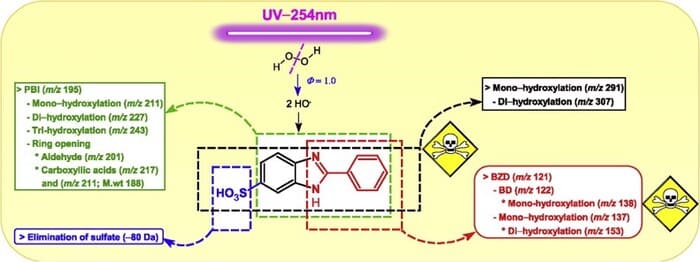
Performance Evaluation: PBSA was completely removed within 15 min (kobs = 0.336 min-1), far exceeding UV/H2O2 (kobs = 0.017 min-1), and the electrical energy per order was 45.7 kW·hr order-1 m-3, about 95% lower than UV/H2O2 (903.5). TBA reduced kobs to 0.096 min-1, while PhOH and pBQ gave 0.002 min-1 and FFA 0.067 min-1, confirming ·OH, CO3·-, O2·- and 1O2 involvement. ·OH contributed only 4.26%, 6.80% and 12.16% at pH 4, 7 and 10. Thirteen byproducts formed via hydroxylation, oxidation, imidazoline ring cleavage, desulfonation and benzene ring cleavage; TOC removal was only 12% after 120 min, yet no obvious toxicity appeared. Real water systems were fully treated within 50 min.


 Abdelraheem, Wael HM, et al. Chemical Engineering Journal 288 (2016): 824-833.