 Klang, Victoria, et al. Pharmaceutics 3.2 (2011): 275-306.
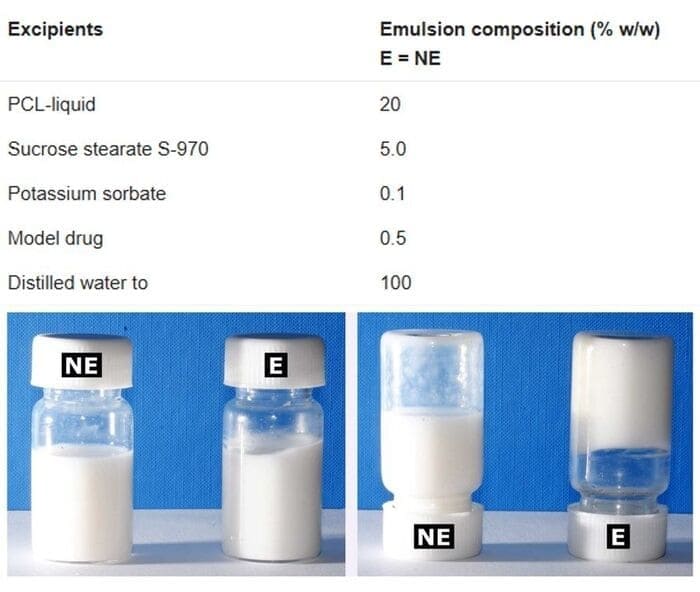
Developing effective dermal drug delivery systems requires formulations that balance ease of application, stability, and efficient drug release. This study investigated the unique functionality of sucrose stearate, a surfactant of intermediate lipophilicity, in creating stable oil-in-water (O/W) emulsions with tunable rheology-from fluid nanoemulsions to highly viscous creams-using the same compositional ingredients.
Formulation Development:Sucrose stearate was employed as the primary emulsifier at a concentration of 5% w/w. The core innovation involved manipulating the production process to yield two distinct formulation types from an identical composition of surfactant, cosmetic oil (PCL-liquid), water, and preservative:
· Semi-Solid Macroemulsions: The surfactant was dissolved in the oil phase. The aqueous phase was slowly added, followed by homogenization with a high-shear mixer. This process, particularly when followed by refrigerated storage, resulted in a highly viscous, creamy emulsion.
· Fluid nanoemulsion: sucrose stearate dissolved in the aqueous phase; oil added into aqueous phase and subjected to high-pressure homogenization (16 cycles at 750 bar) after Ultra-Turrax pre-mixing to yield a low-viscosity nanoemulsion.
Key Results: In the macroemulsions, sucrose stearate formed an extensive, gel-like hydrophilic network at the 5% w/w concentration. Finer surfactant aggregates were observed in the nanoemulsions. Despite the significant difference in macroviscosity and the internal network structure of the semi-solid emulsions, Franz cell diffusion and in vitro tape-stripping studies showed that the release profile of incorporated lipophilic model drugs (e.g., flufenamic acid, diclofenac acid, curcumin) was not hindered.


 Hu, Xin, et al. Food Hydrocolloids 121 (2021): 107002.