

Catalog NumberHG68131044
CAS Number68131-04-4
CategoryAnionic Surfactants
Use as chelating agent.
Sodium Humate Reduces Diarrhea and Improves Immunity in Pre-Weaned Dairy Calves
 Wang, Dong, et al. Animals 12.1 (2022): 123.
Sodium humate (NaH), a multifunctional natural polymer extracted from lignite, weathered coal and peat, was evaluated as a dietary supplement to improve growth performance, immune and antioxidant status, and fecal microflora of pre-weaned Holstein dairy calves.
Experimental Protocol: In a 53-day trial, forty healthy newborn female calves (initial body weight 40.1 ± 1.9 kg) were randomly assigned to four groups of ten: a control (basal diet) and basal diet supplemented orally with 1, 3 or 5 g NaH dissolved in 100 mL of milk (days 2-20) or milk replacer (days 21-53); the NaH product was 75% humic acid. Body weight was measured weekly, fecal score monitored daily, and blood collected on day 54. Fecal bacterial abundances were quantified by real-time qPCR, while serum immunoglobulins, cytokines, antioxidant indices and metabolites were analyzed by ELISA and kit assays.
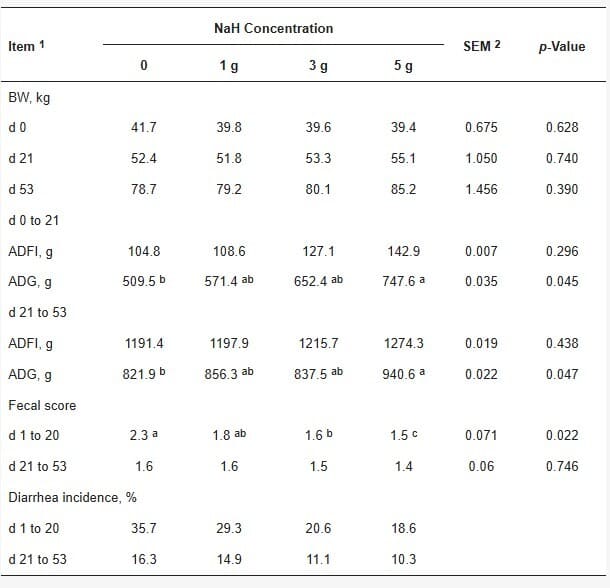
Performance Evaluation: Calves receiving 5 g NaH had higher average daily gain during days 1-20 (747.6 vs. 509.5 g) and days 21-53 (940.6 vs. 821.9 g) than controls (p < 0.05). Fecal scores were lower in the 3 g and 5 g groups, and diarrhea incidence during days 1-20 fell from 35.7% to 18.6% at 5 g. The 5 g group showed higher serum IgA (80.54 vs. 69.13 µg/mL), IgG (1128.50 vs. 985.02 µg/mL), IL-4, T-SOD and T-AOC, and lower IL-6, TNF-α, D-lactic acid and MDA. Fecal Bifidobacterium and Lactobacillus increased while Escherichia coli decreased (p < 0.05), making 5 g NaH the optimum dose.
Sodium Humate-Modified Superabsorbent Resin with High Water Absorbency and Slow-Release Fertilizer Properties
 Yu, Xianglin, et al. Materials Today Communications 19 (2019): 124-130.
Sodium humate (SH), an organic macromolecule rich in hydrophilic hydroxyl, enol, sulfonic acid and carbonyl groups, was introduced into a superabsorbent resin (SAR) to add fertilizer slow-release and biodegradability to water-retention materials.
Experimental Protocol: A poly(acrylic acid)/2-acrylamide-2-methyl propyl sulfonic acid/chitosan/sodium humate (PAA/AMPS/CTS/SH) SAR was prepared by inverse suspension polymerization using potassium persulfate (KPS) as radical initiator, N,N-methylene bisacrylamide (MBA) as crosslinker, Span80/cyclohexane as the oil phase, 70% neutralized acrylic acid and SH. The reaction ran at 70 °C and 250 rpm for 30 min; the product was washed with ethanol, dried at 80 °C and milled. Structure and morphology were characterized by FTIR, optical microscopy and thermogravimetric analysis, and the effects of initiator content, crosslinker content, oil/water ratio and temperature on water absorbency were investigated in deionized water and 0.9 wt% NaCl solution.
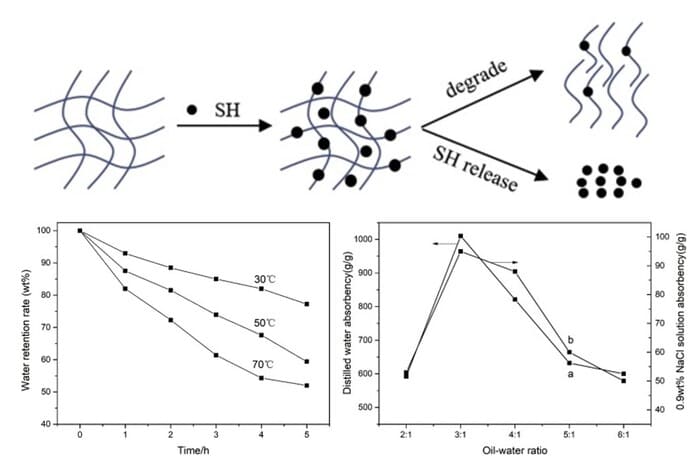
Performance Evaluation: Under optimum conditions the SAR reached a water absorbency of 1097 g/g in deionized water and 103 g/g in 0.9 wt% NaCl, with maximum absorbency at 1.2% KPS. SH release followed a two-stage profile, fast over the first 12 days (carbon content 0.218 mg/5 mL) then slower from 12-30 days (0.242 mg/5 mL). The resin retained good water retention (77.2%, 59.4% and 52.9% after 5 h at 30, 50 and 70 °C) and degraded by 31.9% in soil after 100 days; SH addition also improved moisture resistance (about 2%) and salt tolerance.
pH- and Metal-Ion-Responsive Interfacial Behavior of Sodium Humate as a Pickering Emulsifier
 Lian, Xiaodong, et al. Langmuir 36.36 (2020): 10838-10845.
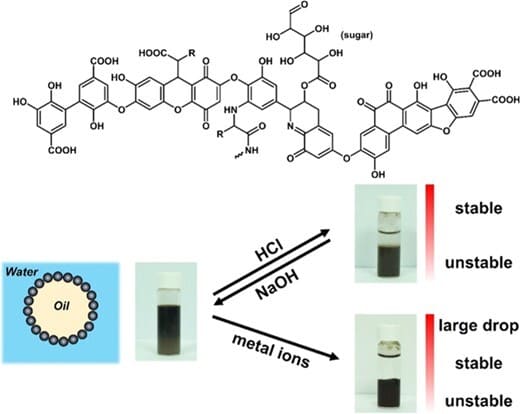
Sodium humate (SH), the sodium salt of humic acid, is an amphiphilic, green and low-cost biosurfactant whose oil/water interfacial behavior responds to the external chemical environment; this work investigated how pH and metal ions govern that behavior and proposed humic acid-based surfactants as Pickering emulsifiers for the first time.
Experimental Protocol: SH aqueous solutions (5.00 mg/mL) were adjusted from the pristine pH 10.0 down to pH 1.0, and oil-in-water emulsions were prepared with chloroform (heavy oil) or n-hexane (light oil) at a water/oil volume ratio of 3:1 by high-speed homogenization. Characterization included optical and fluorescence microscopy (Nile Red labelling), UV-Vis-NIR spectroscopy, zeta potential, dynamic light scattering, acid titration and FTIR of freeze-dried samples. Metal-ion effects were studied by adding Fe3+, Cu2+ and Ca2+ as well as a Na+ control, and pendant-droplet shrinkage was used to probe interfacial adsorption.
Performance Evaluation: SH precipitated at pH below 5.0, and emulsion droplets became smaller as pH decreased-58.8 ± 17.5, 43.1 ± 14.0 and 29.8 ± 13.1 µm at pH 5, 3 and 1, respectively. Zeta potential fell below 30 mV at pH below 3.0, and titration gave pKa values of 4.3 (phenolic hydroxyl) and 8.2 (carboxyl). Fe3+ caused precipitation at 4.0 mM while Ca2+ and Cu2+ did so at 6.0 mM, with association strength Fe3+ > Cu2+ > Ca2+, whereas Na+ caused none.
Ternary KH560/Sodium Humate/SDS Modification of Superfine SiC Powders for High-Density Green Bodies
 Zhang, Wenxiao, et al. Ceramics International 47.17 (2021): 23834-23843.
Sodium humate was employed as one of three modifiers for the aqueous dispersion of superfine silicon carbide (SiC) powders, a critical step for producing high-density SiC green bodies by slip casting.
Experimental Protocol: As-received superfine SiC powder (D50 1.595 µm, purity 99.0%) was first modified with the silane KH560 in ethanol/water (95:5 vol%) and then with sodium humate and sodium dodecyl sulfate (SDS) in deionized water; the optimum conditions were 0.5 wt% KH560 at 90 °C for 4 h, followed by 0.7 wt% sodium humate and 0.1 wt% SDS at 90 °C for 2 h. Slurries at 45-50 vol% solids were characterized by viscosity, zeta potential and sedimentation, while powders were analyzed by XRD, SEM, TEM, HR-TEM, XPS and thermogravimetry (TG). Green bodies were cast from a 67.5 vol% slurry containing modified and coarse SiC at a 1:1 ratio.
Performance Evaluation: The modified SiC slurry reached a minimum viscosity of 0.168 Pa·s at 50 vol% solids, and the maximum absolute zeta potential rose from 47.3 to 61.6 mV, an increase of 14.3 mV, with the isoelectric point shifting from pH 4 to pH 2.7. The most stable suspension occurred at pH 10. TG showed a 0.43 wt% greater weight loss for modified SiC (0.56 wt% at 300-950 °C vs. 0.13 wt% at 400-750 °C), confirming modifier adsorption. Slip casting gave a dense green body of 2.643 g/cm3 (82.06% relative density).