

Catalog NumberHG151213
CAS Number151-21-3
CategoryAnionic Surfactants
Use as cleansing agent.
Use as emulsifying agent, dispersing agent.
Use as wetting agent.
Sodium Dodecyl Sulfate Micelle Structure via Molecular Dynamics Simulation
 Chun, Byeong Jae, et al. Colloids and Surfaces A: Physicochemical and Engineering Aspects 474 (2015): 36-43.
A 20-nanosecond all-atom molecular dynamics simulation was performed on a sodium dodecyl sulfate (SDS) micelle comprising 60 monomers to elucidate internal structure, surface characteristics, and molecular transport properties.
Experimental Protocol: The SDS micelle (aggregation number = 60) was constructed by radial arrangement and solvated with 24,650 F3C water molecules in a 91.4 × 91.4 × 91.4 ų box. MD simulations used the Dreiding force field with B3LYP/6-31G(d,p)-derived partial charges. After 18 ns NVT equilibration, a 20 ns NPT production run at 300 K and 1 atm was performed. Connolly surface analysis used a 1.4 Å probe. Steered MD simulations calculated the potential of mean force (PMF) for water penetration into the micelle core and SDS dissociation from the micelle, using six independent trajectories each at a steering rate of 2.0 × 10⁻⁵ Å/fs.
Performance Evaluation: The equilibrated micelle had a radius of gyration of ~16 Å and geometric radius of ~21 Å, in agreement with experimental SAXS data. Connolly analysis revealed that ~58% of the micelle surface was occupied by hydrophobic alkyl tails, as the 60 sulfate head groups were insufficient to fully cover the surface. SDS molecules adopted significantly bent conformations, with tail-to-head vectors deviating ~68° from the radial direction. Internal free volume was only ~139 ų (0.35% of micelle volume), indicating a well-packed hydrophobic core. The PMF for water penetration was ~10 kcal/mol, and for SDS dissociation was ~13 kcal/mol, both demonstrating that micellization is driven by minimizing unfavorable alkyl tail-water interactions.
Sodium Dodecyl Sulfate Surface Modification of Nano-Silica for Hydrophobic Functionalization
 Qiao, Bing, et al. Applied Surface Science 364 (2016): 103-109.
Sodium dodecyl sulfate (SDS) was employed as a surface modifier to render hydrophilic nano-silica particles hydrophobic, addressing the challenge of nanoparticle agglomeration in organic matrices. Unlike conventional silane coupling agents that require organic solvents, this approach leverages the water solubility of SDS for superior dispersion and contact with silica surfaces.
Experimental Protocol: Nano-silica particles (20 nm, BET surface area 163 m2/g) were mixed with SDS in an aqueous solution at varying SDS/SiO2 mass ratios (0-75 wt%). The slurry was spray-dried and then thermally treated in a sealed steel pipe at 150-250 degrees C for 0-2 h. Unreacted SDS was removed by ethanol washing. Hydrophobicity was assessed via water contact angle measurements, and grafting was confirmed by FTIR, TGA, XPS, and XRD. Comparative modification was also performed on TiO2 and silica-coated TiO2 particles.
Performance Evaluation: The optimal condition was an SDS/SiO2 ratio of 20 wt% with thermal treatment at 200 degrees C for 30 min, yielding a water contact angle of 107 degrees and a grafting density of 1.82 molecules/nm2, approaching the theoretical monolayer limit. FTIR confirmed covalent grafting via C-H stretching bands at 2923 and 2852 cm-1, while TGA showed grafted SDS decomposition at 360-600 degrees C. The reaction mechanism was elucidated: Bronsted acid sites on silica supplied protons that reacted with SDS-derived dodecanol to generate a carbocation, forming a Si-O-C structure confirmed by XPS.
Sodium Dodecyl Sulfate/CTAB Mixed Surfactant System for ZnO Nanomorphology Control
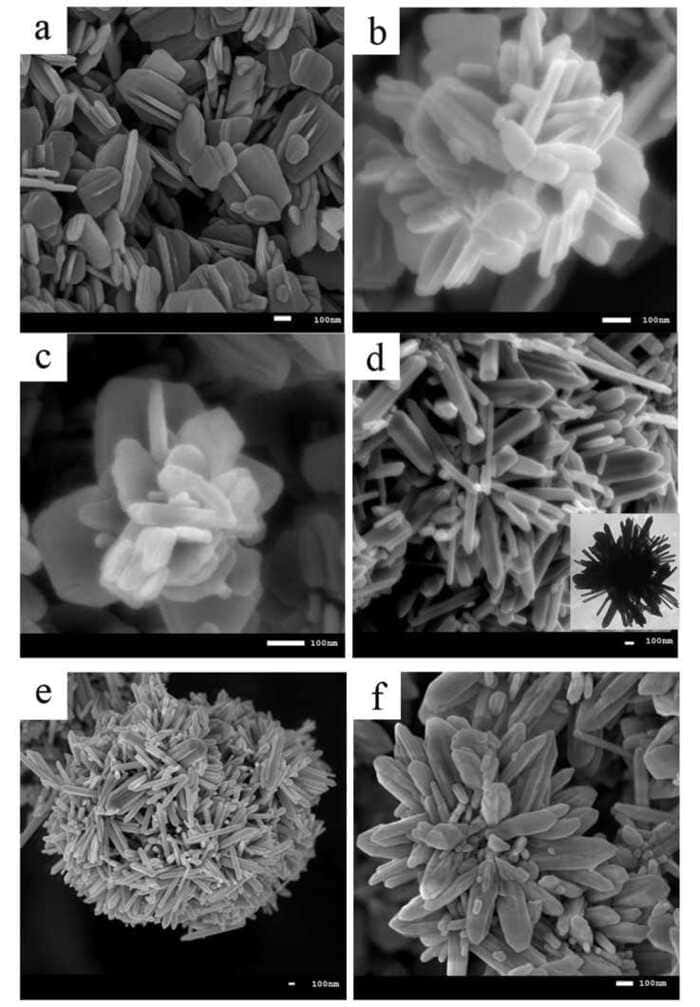 Ramimoghadam, Donya, et al. International journal of molecular sciences 13.10 (2012): 13275-13293.
The mixture of cationic (cetyltrimethylammonium bromide, CTAB) and anionic (SDS) surfactants was investigated for controlling the morphology and physicochemical properties of ZnO nanostructures synthesized via hydrothermal methods, where surfactant-directed growth enables tailored architectures for optoelectronic applications.
Experimental Protocol: ZnO nanostructures were synthesized hydrothermally at 120 degrees C for 18 h using zinc acetate as the precursor and NaOH to adjust pH to 13. Two surfactant series were prepared: (A) constant SDS with varying CTAB molar ratios (SDS:CTAB = 1:0 to 1:2) and (B) constant CTAB with varying SDS molar ratios (CTAB:SDS = 1:0 to 1:1.5). Products were characterized by FESEM, TEM, XRD, TGA-DTG, FTIR, BET surface area analysis, and UV-visible spectroscopy.
Performance Evaluation: With SDS alone, ZnO formed nanoflakes and nanorods. Adding CTAB at a molar ratio of 0.5 produced aggregated nanosheets; at 1.0, rose-like structures composed of nanoflakes; at 1.5, hexagonal rods forming spherical outlines (2-3 micron length, 50-250 nm diameter); and at 2.0, smaller rods (1 micron, 50-150 nm) coexisting with flower-like structures. In the CTAB-constant series, increasing SDS transformed morphologies from nanoflakes to branched rod-like structures and eventually triangular nanoparticles (100-300 nm). The BET surface area reached 29 m2/g at CTAB:SDS = 1:0.36. Cationic-anionic surfactant mixing shifted the ZnO characteristic FTIR peak to lower wavenumbers, an effect partially reversed by calcination.