 Antika, L. D., D. Triana, et al. 462, 1, 2020.
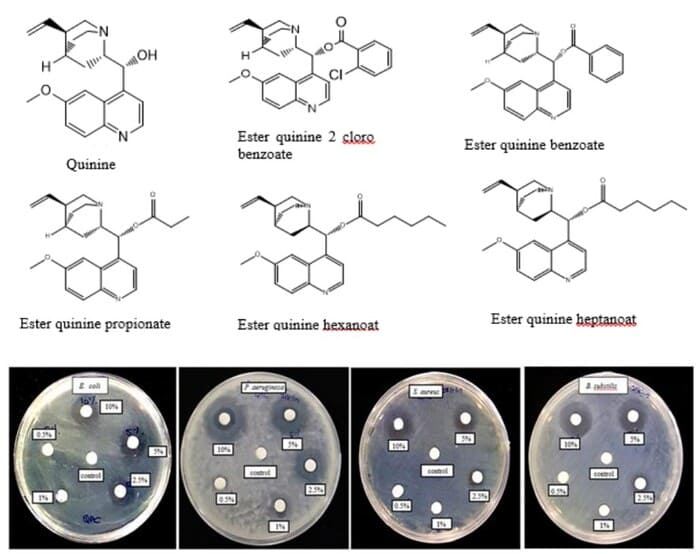
Quinine is an alkaloid compound that was initially used to treat malaria. Quinine has also been found to have antibacterial properties. The present case is aimed to determine the antimicrobial activity of a series of quinine derivatives on some of the common bacteria known to cause infections in human beings.
The antimicrobial activity of newly synthesized quinine derivatives was evaluated against selected Gram-positive and Gram-negative bacterial strains, including Escherichia coli, Staphylococcus aureus, Pseudomonas aeruginosa, and Bacillus subtilis. A disk diffusion test was employed as an initial screening method to assess the compounds' ability to inhibit bacterial growth. The performance of the quinine derivatives was quantitatively evaluated and directly compared to the reference antibiotic, streptomycin.
Several quinine derivatives exhibited moderate antibacterial activity relative to quinine itself across the tested strains. Ester quinine propionate produced the largest inhibition zones among the derivatives, with a reported range of 9.0 mm to 23.5 mm against the tested bacteria. For comparison, streptomycin produced inhibition zones in the range of 8.0 mm to 12.0 mm under the same screening conditions. The study concluded that the quinine derivatives reduced growth of the tested pathogenic strains, indicating potential as antimicrobial agents.


 Moliterno, Mauro, et al. Angewandte Chemie 128.22 (2016): 6635-6639.