

Catalog NumberHG25038599
CAS Number25038-59-9
CategoryPolymer Surfactants
Use as non-metallic material.
Use as adhesive.
Polyethylene Terephthalate in the Design of Antibacterial Surfaces for Healthcare Applications
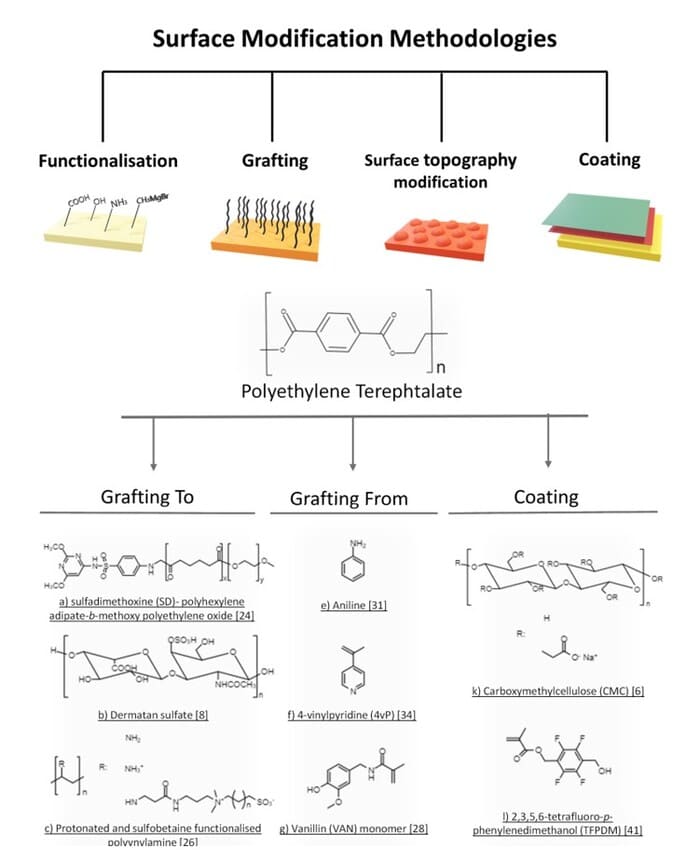 Çaykara, Tugçe, et al. Medical microbiology and immunology 209.3 (2020): 363-372.
Polyethylene terephthalate (PET) is extensively used in healthcare for vascular prostheses, sutures, heart valves, surgical meshes, and catheters due to its biocompatibility, mechanical strength, and chemical resistance. Despite these advantages, bacterial contamination remains a persistent challenge. Bacteria form biofilms on PET through extracellular polymeric substances that render attachment irreversible, after which rapid multiplication produces mature biofilms resistant to antibiotics, providing a source for systemic chronic infections.
A comprehensive review was conducted of PET surface modification strategies for antibacterial applications. Methods evaluated included surface functionalisation with antimicrobial compounds, covalent grafting of bioactive molecules, topographical modification to alter roughness and wettability, and application of antibacterial coatings. Water contact angle measurements, bacterial adhesion assays, and biocidal activity testing were examined across published studies.
Key Findings: Among the reviewed strategies, covalent grafting demonstrated particular promise for healthcare applications by permanently attaching antimicrobial agents through stable chemical bonds, providing durable antibacterial activity while mitigating bacterial resistance emergence. Surface functionalisation and coating methods offered variable efficacy depending on the specific compound and processing conditions. The combined influence of surface charge, energy, hydrophilicity, and roughness made it difficult to isolate individual factors affecting bacterial adhesion, highlighting the need for systematic, multivariate experimental design in future research.
Polyethylene Terephthalate Film Coated with PAA/Montmorillonite for Gas Barrier Enhancement
 Lim, Ji Woo, et al. Packaging Technology and Science 34.3 (2021): 141-150.
PET films are extensively used in food packaging, but their inherent gas barrier properties are insufficient for oxygen-sensitive products. Multilayer coating with polymer-nanocomposites can enhance barrier performance by introducing impermeable inorganic nanofillers that create tortuous pathways for gas molecules. Polyacrylic acid (PAA) is an eco-friendly polymer with multiple carboxylic acid groups that produce nontoxic products, making it safe for food-contact applications without requiring organic solvents during coating.
Experimental Protocol: Corona-treated PET films were coated with PAA blended with montmorillonite (MMT) at 0, 1, 3, and 5 wt%. MMT dispersion was enhanced using ultrasonication and microwave treatment (100 W or 300 W). Coated films were characterized by field-emission scanning electron microscopy, X-ray diffraction, and Fourier transform infrared spectroscopy. Water vapor and oxygen permeability were quantitatively measured.
Performance Evaluation: The 300-W microwave treatment was most effective for MMT particle size reduction. Even at 5 wt% MMT loading, good optical transmittance in the visible region (500 nm) was maintained, comparable to neat PET film. Water vapor and oxygen barrier properties were significantly enhanced by PAA coating, with further improvement achieved by blending 1 and 3 wt% MMT. The PET film coated with PAA/MMT nanocomposites demonstrated suitability for food packaging applications requiring high gas barrier performance for oxygen-sensitive products.
Polyethylene Terephthalate Surface via Atmospheric Plasma for Silver Nanoparticle Adhesion
 Shen, Tao, et al. Applied Surface Science 411 (2017): 411-418.
Silver nanoparticles (Ag NPs) have attracted attention as broad-spectrum antibacterial materials for textile and polymer surfaces. However, adhesion of noble metal nanoparticles to nonreactive polymer surfaces such as PET is generally too weak for practical applications, resulting in NP loss and reduced antibacterial effectiveness. A combined physical activation and chemical functionalization strategy can enhance Ag NP immobilization by increasing the density of reactive functional groups available for metal-polymer bonding.
Experimental Protocol: A two-step process was developed: atmospheric plasma treatment of PET followed by surface modification with 3-aminopropyltriethoxysilane (APTES). Plasma treatment generated active sites (-OH, -CHO, and -COOH) on the PET surface. APTES was grafted onto these activated sites, and Ag NPs were immobilized via -NH2-Ag complex formation. Adhesion strength was evaluated by comparing single-step treatments with the combined approach.
Performance Evaluation: Compared to either plasma treatment or surface functionalization applied alone, the two-step combination greatly enhanced Ag NP adhesion to PET surfaces. The plasma treatment increased active site density, permitting greater APTES grafting. The APTES -NH2 groups subsequently formed stable complexes with Ag NPs, providing strong, durable immobilization. This simple, low-cost method is suitable for mass production and offers a practical route to durable antibacterial PET surfaces for medical and textile applications.