

Catalog NumberHG1327419
CAS Number1327-41-9
CategoryPolymer Surfactants
Polyaluminium Chloride Coagulation Behavior: Effects of pH and Coagulant Dosage
 Wei, Ning, et al. Chinese Journal of Chemical Engineering 23.6 (2015): 1041-1046.
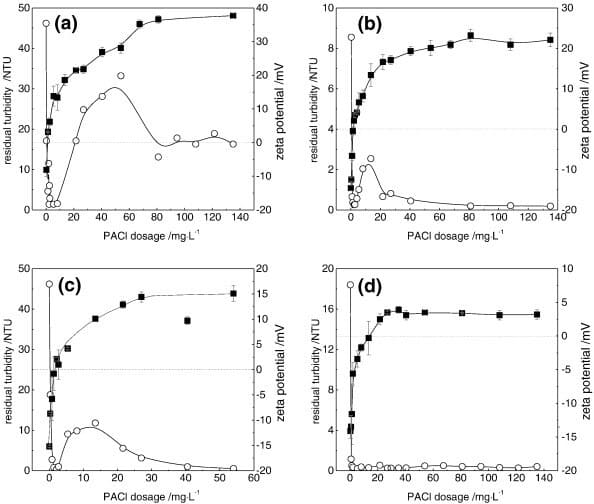
Coagulation mechanisms of polyaluminium chloride (PACl) were systematically investigated across varying dosages and pH values using kaolin suspension as a model system, with coagulation zone diagrams developed for comparison with alum.
Experimental Protocol: A 100 mg/L kaolin suspension (turbidity 68 NTU, mean volume diameter 7.28 μm) was coagulated with PACl (basicity 1.35, Al2O3 30%) at dosages of 0-135 mg/L as Al. Final pH values were fixed at 6.0, 7.0, 8.0, and 10.0 using HCl/NaOH. Additional experiments at initial pH 7.6 and 9.3 without final pH control were conducted. Jar tests followed standard protocol: rapid mixing at 245 /s (3 min), slow mixing at 15 /s (10 min), and settling (10 min). Residual turbidity and zeta potential were measured. PACl precipitate formation and zeta potential were characterized as a function of pH.
Performance Evaluation: Four classic coagulation zones-stabilization, charge neutralization destabilization, restabilization, and sweep-occurred sequentially with increasing PACl dosage at final pH 7.0 and 8.0. The restabilization zone disappeared at final pH 10.0. At uncontrolled final pH, no typical sweep zone was observed. Charge neutralization was the optimal mechanism at pH < 7.0, while both charge neutralization and sweep coagulation achieved high efficiency at pH 7.0-10.0. Compared with alum, PACl exhibited broader charge neutralization and sweep coagulation zones, required higher Al-equivalent dosages, and the restabilization zone disappeared at a higher pH. The optimal pH for PACl coagulation correlated with maximum PACl precipitate formation.
Polyaluminium Chloride as Alternative to Alum for Direct Filtration of Drinking Water
 Zarchi, Idit, et al. Environmental technology 34.9 (2013): 1199-1209.
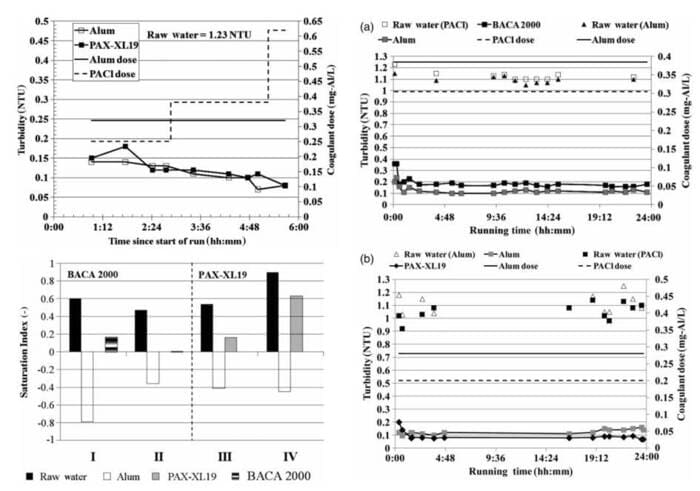
Polyaluminium chloride (PACl) was evaluated as an alternative to aluminium sulfate (alum) for coagulation-flocculation preceding direct filtration in surface water treatment at pilot scale, with particular emphasis on economic benefits and aluminium speciation.
Experimental Protocol: Eight commercially available PACls with basicities ranging from 40-85% were tested against alum in a pilot filtration plant with two parallel treatment trains using 3 m height, 0.3 m diameter anthracite media filters. Surface water from the Sea of Galilee (turbidity ~1 NTU) was treated at filtration velocities of 17-19.8 m/h. Short runs (5-7 h) screened all PACls; two selected PACls were tested in 24-h long runs. Aluminium speciation was analyzed by the ferron assay method, classifying species as monomers (Ala), polymers (Alb), and large polymers/colloids (Alc).
Performance Evaluation: All eight PACls reduced filtered water turbidity to ≤0.2 NTU. Selected PACls (BACA 2000, PAX-XL19) performed as well as or better than alum during 24-h runs, reducing particle counts by 95-99%. PACls did not require acid addition for pH adjustment or subsequent caustic soda for restabilization, yielding approximately 86% savings in chemical costs. Speciation experiments revealed that low-basicity PACl changed its speciation with pH-transitioning from monomers to Alb-prevalent polymers at neutral pH-while high-basicity PACl retained stable polymeric speciation across pH 4.49-8. PACls maintained a sizable polymer fraction at all tested pH values, explaining their efficiency over a wider pH range than alum.
Polyaluminium Chloride Floc Growth Behavior in Ballasted Flocculation Compared with Aluminum Sulfate
 He, Weipeng, et al. Separation and Purification Technology 213 (2019): 176-185.
Floc growth behaviors during ballasted flocculation (BF) were comparatively analyzed using aluminium sulfate (AS) and polyaluminium chloride (PACl) as coagulants with microsand as ballasting agent, focusing on incorporation mechanisms and the role of mixing intensity.
Experimental Protocol: Synthetic kaolin suspension (200 mg/L, turbidity ~96 NTU) was treated in a 1-L jar test apparatus. BF tests followed a cycled-shear procedure: rapid mixing at 600 /s with coagulant (10-100 mg/L), addition of anionic polyacrylamide (2.5 mg/L) and microsand (75-106 μm, 2.5 g), maturation at 200 /s (2 min), breakage at 600 /s (1 min), and reformation at 200 /s (2 min). Ballasted floc size was measured by laser diffraction; zeta potential was determined at four representative moments. Floc strength factor was calculated as the ratio of characteristic sizes before and after breakage.
Performance Evaluation: Higher coagulant dosages of both AS and PACl led to poorer incorporation of ballasting agent (BA) particles due to limited binding sites on the fixed-dose polymer, resulting in smaller ballasted flocs after maturation. At lower dosages, breakage occurred via fragmentation; at higher dosages, erosion-like breakage dominated. A turning point in the floc size curve after breakage was observed for both coagulants, attributed to stretched polymer conformations under higher shear (600 /s) providing more available binding sites. PACl at the same dosage produced flocs with stronger binding bonds than AS, leading to larger aggregate sizes after reformation. Poor BA incorporation worsened settling performance, increasing residual turbidity by up to 349% for AS and 145% for PACl.