 Johnson Jr, Wilbur, et al. International journal of toxicology 35.2_suppl (2016): 12S-40S.
PEG-120 methyl glucose dioleate (CAS 86893-19-8), the polyethylene glycol ether of the diester of methyl glucose and oleic acid averaging 120 moles of ethylene oxide (molecular weight 6,037 Da), functions in cosmetics as a surfactant and cleansing agent. The Cosmetic Ingredient Review Expert Panel assessed the safety of methyl glucose polyethers and esters.
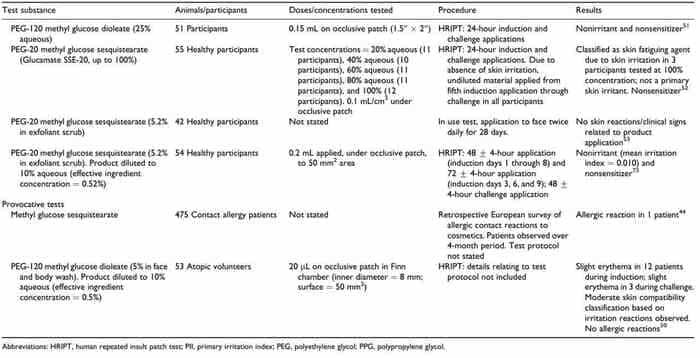
Experimental Protocol: The Panel reviewed available animal and clinical data, including molecular weights, log Kow values and physicochemical properties; where data gaps existed, extrapolation across the group relied on structural, physicochemical and biological similarities and on cosmetic use concentrations. Data on PEG-120 methyl glucose dioleate included acute oral toxicity in rats, a Draize ocular irritation test in rabbits, an in vitro sheep red blood cell hemolysis and protein-denaturation assay, human repeated insult patch tests and an Ames genotoxicity test.
Performance Evaluation: The acute oral LD50 was >5 g/kg in rats. In rabbits it was a slight ocular irritant (maximum average Draize score 8.8; H50 = 1,125.56 mg/mL; denaturation index 12.82%; H50/DI = 87.80), although 100% material induced no ocular irritation and reduced irritation caused by SLS and AOS. At 25% aqueous it was nonirritant and a nonsensitizer in 51 participants; a 5% face and body wash caused only slight erythema. Up to 5,000 ug/plate it was not genotoxic. The Panel concluded there would likely be no significant systemic exposure and that these ingredients are safe in present practices of use, PEG-120 methyl glucose dioleate being used in face and body powders up to 4%.


 Jacksch, Susanne, et al. International Journal of Cosmetic Science 46.1 (2024): 62-70.