 Gatapova, Elizaveta Ya, et al. International Journal of Thermal Sciences 206 (2024): 109317.
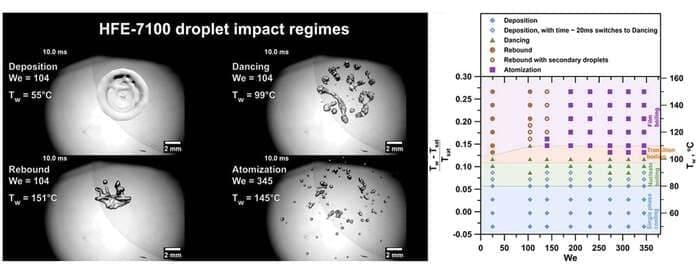
Spray cooling is a highly efficient method for managing heat in high-power electronics, relying on the impact and phase change of dielectric fluid droplets on hot surfaces. This study provided a detailed experimental investigation of methyl perfluoroisobutyl ether (HFE-7100), a dielectric engineering fluid with a low boiling point (61°C), characterizing its performance during droplet impact on a superheated surface to inform the design of advanced cooling systems.
Key Findings:
· Compared to water, HFE-7100 exhibited all classical boiling regimes (including nucleate, transition, and film boiling) at significantly lower wall superheat levels. The rebound regime was observed across a much wider range of Weber numbers (up to 150) for HFE-7100 versus water (up to 50).
· At high Weber numbers and high superheat, HFE-7100 droplets demonstrated a distinctive mechanism: the droplet spread over a vapor layer, levitating as a thin film before rupturing and atomizing into small secondary droplets.
· For high We (≈150), the maximum spreading diameter is larger in the film-boiling levitation regime than in other regimes. The fluid's low boiling point allows for a substantial wall superheat (tens of degrees) at typical maximum junction temperatures (e.g., 120°C), which is a key driver for efficient heat transfer coefficients in practical applications.
· Dielectric safety + different heat-transfer scaling: HFE-7100 permits close proximity cooling of electronics because it is dielectric; however, its lower latent heat and different spreading dynamics mean system-level tradeoffs (pump/flow rates vs achievable cooling) differ from water-based systems.


 Yang, Min, et al. International Journal of Heat and Mass Transfer 160 (2020): 120230.