 Schulreich, Christoph, et al. Colloids and Surfaces A: Physicochemical and Engineering Aspects 418 (2013): 39-46.
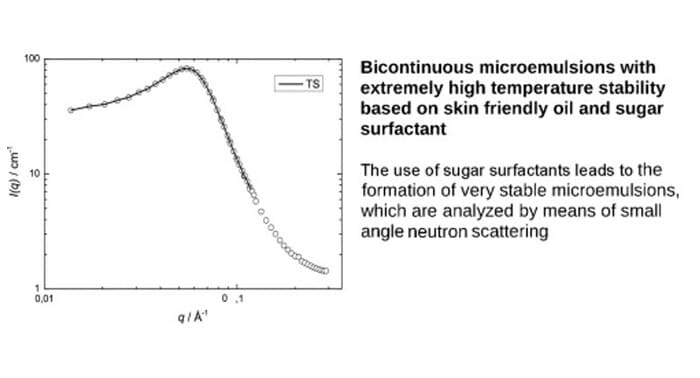
It can be difficult to make microemulsions that function properly over a broad temperature range, which is a common requirement in cosmetic and pharmaceutical applications. This work demonstrated the suitability of isononyl isononanoate as the oil component in bicontinuous microemulsions that retain a stable internal nanostructure over a wide temperature range, using a skin-friendly sugar surfactant and benzyl alcohol as cosurfactant.
Key Findings
· Bicontinuous phase formation: isononyl isononanoate with sugar surfactant and benzyl alcohol forms a bicontinuous microemulsion in the presence of water/D2O.
· X-point shift with D2O: Addition of D2O altered the X-point composition from γ = 0.2625, δ = 0.1325 (H2O case) to γ = 0.2600, δ = 0.1125 (D2O case); overall surfactant fraction remained nearly unchanged while cosurfactant fraction (δ) decreased.
· Exceptional temperature stability: SANS showed the internal structure is essentially temperature-independent between 261 K and 273 K. From 283 K to 343 K the correlation length decreased linearly by ≈10 Å, while the domain size increased linearly by ≈10 Å over the same interval. These modest, systematic changes were attributed primarily to small solubility changes of the surfactant with temperature.
· The renormalized bending elasticity constant derived from ξ and d showed no significant abrupt change across the studied temperature range, indicating consistent membrane elasticity and robust bicontinuous architecture.
· At the lowest temperatures examined the water domains within the microemulsions remained in a supercooled liquid state, consistent with prior neutron studies of comparable systems.


 Walsh, A., et al. Langmuir 26.23 (2010): 18039-18048.