 Wang, Xinyao, et al. International Journal of Biological Macromolecules 263 (2024): 130081.
Bigels, biphasic systems combining an oleogel and a hydrogel, present a promising strategy for creating fat-reduced alternatives. This study investigated the role of glyceryl monolaurate as a key oleogelator in formulating structured bigels designed to mimic the desirable properties of solid fats.
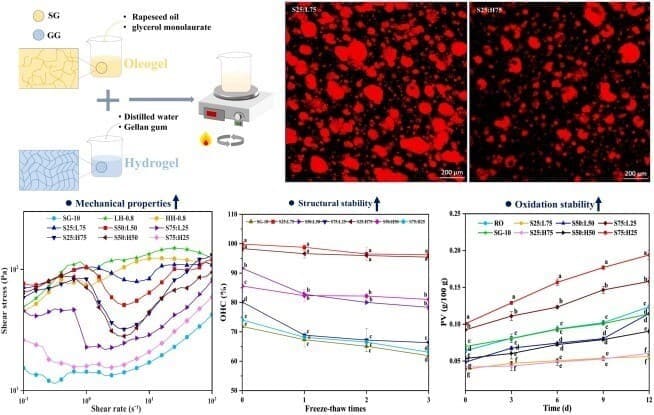
Formulation: Formulate bigels by combining a glyceryl monolaurate (GML) oleogel (10 wt%) with a gellan gum hydrogel (0.8 wt%) and vary the oleogel : hydrogel mixing ratio to tune structure and physical properties. Three mass ratios were prepared and compared: 1:3, 1:1 and 3:1 (oleogel : hydrogel). Two formulations from the study are identified as S25:L75 and S25:H75 (high-acylated gellan gum (HA) and low-acylated gellan gum (LA)) and were highlighted for performance.
Key Findings
· The ratio of oleogel to hydrogel directly determined the internal phase morphology. As the proportion of the glyceryl monolaurate oleogel increased, the bigel structure transitioned from oil-in-water, to bi-continuous, and finally to water-in-oil configurations. Hardness, gumminess, chewiness and cohesiveness all increased as the hydrogel fraction rose.
· Bigels with oleogel : hydrogel = 1:3 (S25:L75 and S25:H75) retained excellent oil holding capacity - >95% - after three freeze-thaw cycles, indicating strong physical stability under freezing and thawing. These formulations, measured oxidative markers after 12 days were low: peroxide value < 0.07 g / 100 g and malondialdehyde < 1.5 mg MDA / kg.
· The biphasic architecture and the GML oleogel network permit reduction of total fat while maintaining semi-solid behavior and protecting oil against phase separation and oxidation under the tested conditions.


 Kerr, Brian J., et al. Poultry Science 103.12 (2024): 104442.