 Campaña-Seoane, Maria, et al. International journal of pharmaceutics 477.1-2 (2014): 495-505.
Effective vaginal drug delivery requires formulations that can resist clearance by bodily fluids to ensure prolonged therapeutic effect at the target site. This presents a significant challenge for hydrophilic systems. This study explored the application of cyclomethicone (specifically the pentamer) as a key silicone-based, water-resistant material in the development of a mucoadhesive water-in-silicone (W/S) emulsion for the controlled release of progesterone.
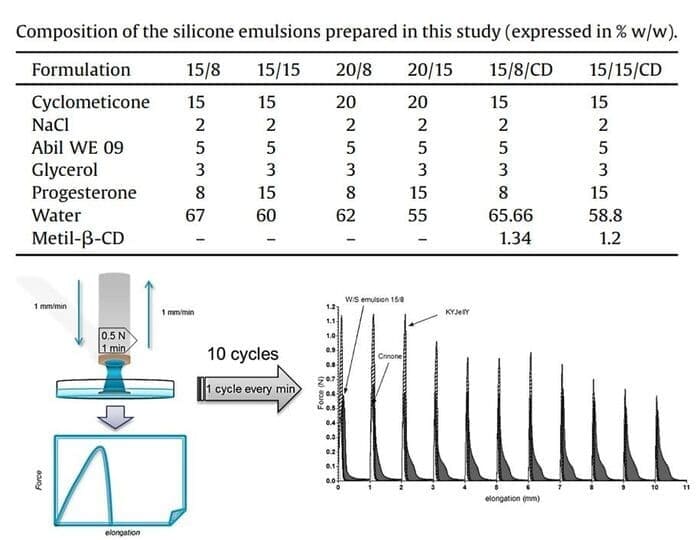
Formulation: Cyclomethicone served as the primary continuous silicone phase in formulating W/S emulsions. Progesterone was incorporated into the formulation at two loadings (8% and 15% w/w). To enhance the drug's solubility in the aqueous internal phase, methyl-β-cyclodextrin was utilized. The emulsions were prepared via direct emulsification, homogenizing the silicone phase (containing cyclomethicone and an emulsifier blend) with an aqueous solution of sodium chloride and glycerol.
Key Results
· While exhibiting bioadhesive levels similar to commercial references under dry conditions, the W/S emulsions uniquely maintained their consistency and mucosal adherence upon exposure to simulated vaginal fluid (SVF). The reference gels showed a drastic loss of these properties.
· The emulsions provided a controlled release of progesterone, following near-zero-order kinetics and maintaining a constant release rate for a period of at least two weeks. A single vaginal administration in rats resulted in increased uterine tissue progesterone levels. Notably, in postmenopausal rats, the W/S emulsions achieved higher uterine progesterone levels compared to the marketed bioadhesive reference gel.


 Bayer, I. S., et al. Applied Surface Science 257.3 (2010): 823-826.