

Catalog NumberHG8061527
CAS Number8061-52-7
CategoryAnionic Surfactants
Use as dispersing agent.
Use as adhesive.
Calcium Lignosulphonate Stabilization Mechanism for Expansive Soil Improvement
 Wu, Dajiang, et al. Journal of Wuhan University of Technology-Mater. Sci. Ed. 35.5 (2020): 847-855.
Calcium lignosulphonate (CLS) was evaluated as an environmentally friendly stabilizer for expansive soil, with a focus on elucidating the stabilization mechanism linking macroscopic properties to microstructural changes.
Experimental Protocol: Natural expansive soil was modified with CLS at 0%, 2%, 4%, 6%, and 8% by weight at 25% moisture content. Specimens (50 mm diameter, 100 mm height) were compacted at 15 kN and cured for 7 and 28 days. Tests included Atterberg limits, unconfined compressive strength (UCS), free expansion rate, and water stability. Microstructural characterization employed X-ray diffraction (XRD) including small-angle XRD, X-computed tomography (X-CT), Zeta potential measurements, and rheological analysis using a soft solid rheometer.
Performance Evaluation: The optimum CLS content was 4%, which increased 28-day UCS from 3.5 to 5.5 MPa (56.5% improvement) and decreased the free expansion rate by 23.8%. Porosity was reduced by 96.7% at 4% CLS, with optimized pore distribution confirmed by X-CT. Small-angle XRD revealed that Ca2+ from CLS exchanged with expansive cations in montmorillonite interlayers, reducing d001 interplanar spacing from 15.12 to 14.77 Å. Zeta potential increased with CLS content, indicating enhanced dispersion stability. Rheological tests demonstrated that moderate CLS (2-4%) reinforced flocculation structure, increasing yield stress and plastic viscosity, while lignosulphonic acid groups preferentially adsorbed at positively charged broken edges of clay particles.
Calcium Lignosulphonate as Selective Depressant for Scheelite/Calcite Flotation Separation
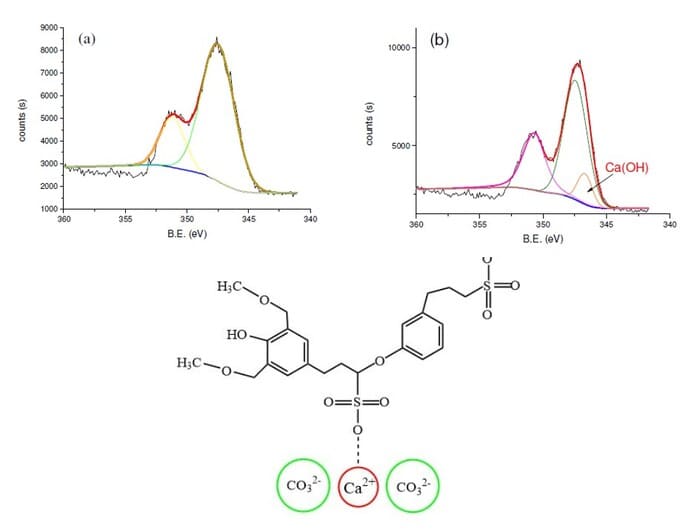 Feng, Bo, et al. Separation and Purification Technology 199 (2018): 346-350.
Calcium lignosulphonate (CLS) was investigated as a selective depressant for separating scheelite from calcite in froth flotation, addressing the challenge posed by similar physicochemical characteristics of these two calcium-bearing minerals.
Experimental Protocol: Pure scheelite (99.06%, 79.80% WO3) and calcite (99.0%, 55.47% CaO) samples were used. Micro-flotation tests employed a 40 mL cell at 1902 rpm with sodium oleate as collector (1.2×10⁻⁴ mol/L) and CLS as depressant at pH 6-11. Adsorption tests measured CLS uptake via total organic carbon analysis. XPS characterization examined the calcite surface before and after CLS treatment to elucidate the interaction mechanism.
Performance Evaluation: CLS exhibited strong selective depression of calcite while showing weak effect on scheelite at pH 6-9. Calcite recovery dropped sharply from 85% to 7% with 100 mg/L CLS at pH 7. A concentrate with 65.02% WO3 grade and 79.64% recovery was achieved from mixed mineral flotation using 30 mg/L CLS. Adsorption tests revealed that CLS adsorption on calcite surface was significantly greater than on scheelite. XPS analysis confirmed chemisorption: the -SO3 groups of CLS interacted with Ca2+ on the calcite surface via Ca-S-O bonds, hindering oleate collector adsorption. Additionally, minor Ca(OH)2 formation further enhanced calcite hydrophilicity.
Calcium Lignosulphonate with Granite Sand for Cohesive Soil Strength Enhancement
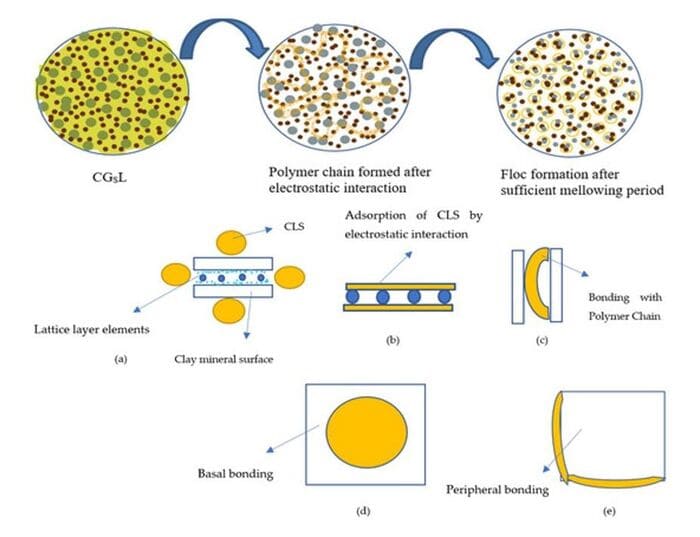 Amulya, Gudla, et al. Buildings 12.10 (2022): 1687.
The coupled effect of granite sand (GS) and calcium lignosulphonate (CLS) on the strength and permeability behavior of cohesive soil was systematically evaluated as a sustainable stabilization approach.
Experimental Protocol: Intermediate plastic clay was mixed with GS at 30%, 40%, and 50% replacement levels, and CLS at dosages of 0.5%, 1%, 1.5%, and 2% by weight. Specimens were prepared at maximum dry density and optimum moisture content, then cured for 0, 7, 14, 28, and 90 days. Unconfined compressive strength (UCS) was tested per ASTM D2166M, and hydraulic conductivity (K) was measured using a falling head permeameter per ASTM D5856. Scanning electron microscopy examined the fabric texture. Nonlinear regression equations were developed to relate UCS and K to GS dosage, CLS dosage, and curing period.
Performance Evaluation: The combined GS-CLS treatment significantly improved UCS performance with increasing curing period. At 28 days, the maximum UCS of 423.8 kPa was achieved for M1 with 0.5% CLS; at 90 days, the maximum reached 2.3 MPa for M2 with 0.5% CLS. The UCS response was most pronounced at the initial CLS dosage (0.5%) across all GS replacements. For clay-GS mixes, 50% GS enhanced permeability by 30 times, while the clay-GS-CLS mixes showed an average 30% decrease in K after 28-day curing. Proposed nonlinear regression equations demonstrated excellent fit with R² > 0.95 for both UCS and K predictions.