 Jiang, Jun, et al. Applied Surface Science 397 (2017): 104-111.
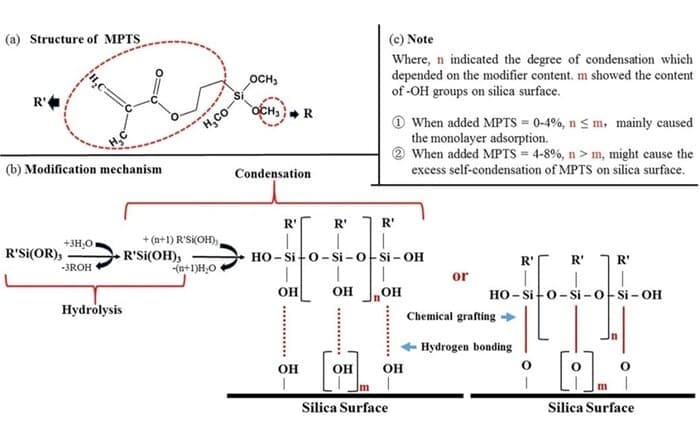
This study investigated the application of γ-methacryloxypropyltrimethoxysilane (MPTS) as a coupling agent to systematically alter the surface properties of silica, focusing on the relationship between silane concentration and the resulting hydrophobicity and moisture uptake.
Modification Process: Silica powders were modified by a standard hydrolytic grafting protocol: Disperse 1 g silica per 100 mL ethanol-water (9:1 v/v). Add MPTS at levels of 2, 4, 6, 8 and 10% (w/w relative to silica) and hydrolyze (pH 3-4 with acetic acid). Heat/stir at 60-70 °C, 500 rpm for 30 min, filter and dry at ~103 °C. Post-treatment included a 24 h water immersion and repeated washing to remove physisorbed species, followed by final drying to constant weight.
Key Results:
· Hydrophobicity increases with MPTS loading. WCA measurements on modified silica films rose progressively with MPTS concentration; films treated at 6% and 8% MPTS exceeded 90° WCA, marking a transition to effectively hydrophobic surfaces.
· Reduced Moisture Uptake: The EMC of the modified silica decreased as the MPTS concentration increased, indicating improved resistance to ambient moisture.
· Optimal Dispersion and Self-Condensation: Silica modified with 8% MPTS demonstrated the least particle aggregation. The study identified that self-condensation reactions of MPTS molecules began to occur at concentrations above 4%, becoming more pronounced at the 8% concentration level. This self-condensation slightly influenced the EMC profile at low relative humidity but contributed to the lowest EMC at higher humidity levels (40-90% RH) due to the combined effect of high hydrophobicity and lower specific surface area.


 Scotland, Kevin M., et al. Journal of Coatings Technology and Research 17.4 (2020): 977-989.